Deloitte India • Digital Ecellence Centre
Governing Human Factors: Inclusive Systems Research at Scale
Inclusive design at the enterprise level isn't about checking boxes; it’s about systemic resilience. I led two independent research initiatives that moved beyond standard WCAG compliance to address real-world cognitive and visual constraints. This work didn't end in a report—it was codified directly into the DEC design system to ensure every platform we build is inclusive by default.
ROLE
Assistant Manager, UXD
TEAM
Content & Design
CONTRIBUTION
Research study for Design Team
ORGANISATION
Deloitte Touche Tohmatsu Pvt Ltd.
Scope
The Governance of Inclusion
Designing for inclusion at scale goes beyond checking accessibility boxes. It requires a fundamental understanding of how visual variance and cognitive load impact the users.
THE INSTINCT
Compliance.
Check the boxes. Meet WCAG 2.1. Follow the standard models.
THE REALITY
Compliance is converge.
A "standard" model is meaningless if it doesn't solve for real world conditions
SYSTEMIC DISCOVERY
01
Foundational Discovery
Moving beyond "user feedback" to vision science and cognitive psychology. Mapping the invisible physiological boundaries that dictate how experts actually perceive data.
02
Stress-Tested Prototyping
Building high-fidelity, dual-mode environments to isolate variables. We tested specifically for halation, visual bleed, and "action-paralysis" under simulated pressure.
03
Technical Tokenization
Translating qualitative findings into hard variables. Every "calm" color and "clear" font weight was converted into a reusable Design Token for the engineering pipeline.
04
Components inside a larger system
Ensuring that a discovery made in an study for improved the accessibility. One insight, infinite application.
THE INVISIBLE DECISIONS
The most important inclusive decisions happen at the atomic level—in the weight of a stroke, the speed of a transition, and the tone of an error.
Standards are the floor, not the ceiling.
Beyond the Checklist
Moving from legal compliance (WCAG) to human-factor performance.
Environmental Stressors
Accounting for 10-hour shifts and high-density data.
Biological Variance
Solving for Astigmatism and neurodiversity as structural constants.
Sustaining Expertise
Designing to protect the expert’s focus, not just to guide a novice.
Work completed at Deloitte. All proprietary content, research data files, process details, internal flow diagrams and interface details are withheld in accordance with confidentiality obligations.
Accessibility Research 01
Designing for Astigmatism
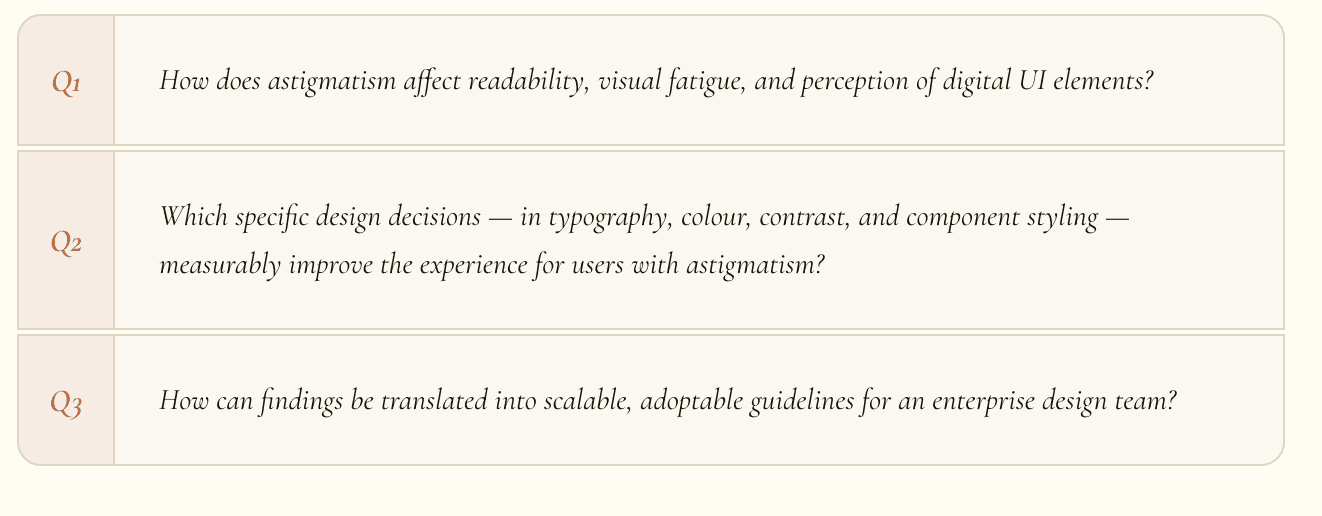
Astigmatism affects 1 in 3 people globally — yet it remains largely absent from mainstream UX accessibility guidance.
This research set out to change that, investigating how the condition affects digital interface perception, and translating evidence-based findings into concrete, actionable design decisions.
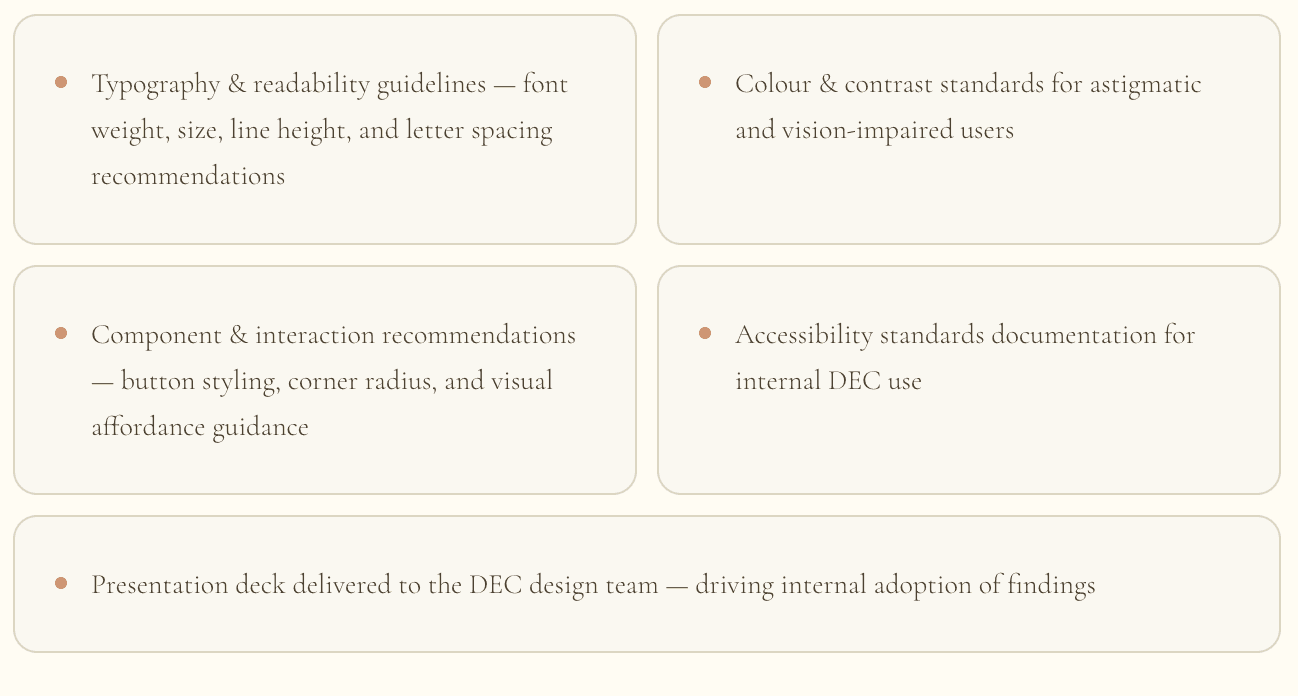
As the sole researcher on this initiative, I led the work end-to-end: from literature review and prototype design through to usability testing, guideline documentation, and a presentation deck for internal adoption across the DEC design team.
RESEARCH QUESTIONS
RESEARCH APPROACH
PARTICIPANTS
72–75
Internal DEC volunteers with diagnosed vision conditions
PROTOTYPE
2 modes
Compared within the same session via live toggle
RECRUITMENT
Open
Anonymous sign-up — all vision-related conditions included
RESEARCH OUTPUTS
Accessibility Research 02
Designing for Mental Health
In enterprise UX, mental health isn't a soft consideration — it is a fundamental dimension of usability.
This research explored how active, intentional design decisions can support and protect the mental wellbeing of users, examining how interface design choices contribute to or reduce stress, cognitive load, anxiety, and emotional safety. led an initiative to move beyond standard accessibility to explore how interface decisions can actively stabilize cognitive load and provide emotional safety for users in high-pressure environments.
THE CHALLENGE
Narrowed to anxiety as the primary mental health condition in enterprise contexts — and defined a colour palette and set of UI decisions specifically optimised to reduce anxiety-related stress responses in high-pressure tools.
Architecture as a cognitive stabilizer.
THE INSTINCT 01
Static Functionalism
The assumption that if a user completes a task quickly, the design is successful—ignoring the internal "emotional cost" or stress experienced during the process.
SIGNAL PROBLEM 02
Action Paralysis
My research identified specific UI triggers in regulatory and risk-management workflows that spike user anxiety and lead to decision-fatigue or "freezing".
SYSTEMIC OUTCOME 03
The Safety Layer
We moved from "standard UI" to an Anxiety-Focused Design Specification, treating cognitive load and emotional calm as functional, measurable design constraints.
RESEARCH QUESTIONS
What design decisions actively reduce cognitive load, stress, and anxiety in digital interfaces?
How can visual design, interaction patterns, and content hierarchy create a sense of calm, control, and safety?
How can visual design, interaction patterns, and content hierarchy create a sense of calm, control, and safety?
RESEARCH OUTPUT
01
Defined an anxiety-focused colour palette and UI decision set — first time mental health was treated as a discrete, actionable design constraint in the DEC system
02
Component and interaction recommendations covering visual hierarchy, spacing, motion, and error handling
03
Colour and contrast guidance for emotional safety and visual calm
04
Internal presentation deck shared with the DEC design team
IMPACT
Scalable Wellbeing
Most enterprise UX practice treats mental health as outside the scope of interface design. This research argued otherwise — that the way information is structured, how errors are communicated, and how much control users feel directly affects wellbeing in tools used under pressure. In Deloitte's own product portfolio, users of platforms like OrgAtlas and Counterparty Due Diligence work with sensitive data under regulatory scrutiny.
Work completed at Deloitte. All proprietary content, research data files, process details, internal flow diagrams and interface details are withheld in accordance with confidentiality obligations.
