Turning system logic into workflow logic
// Enterprise UX at Deloitte

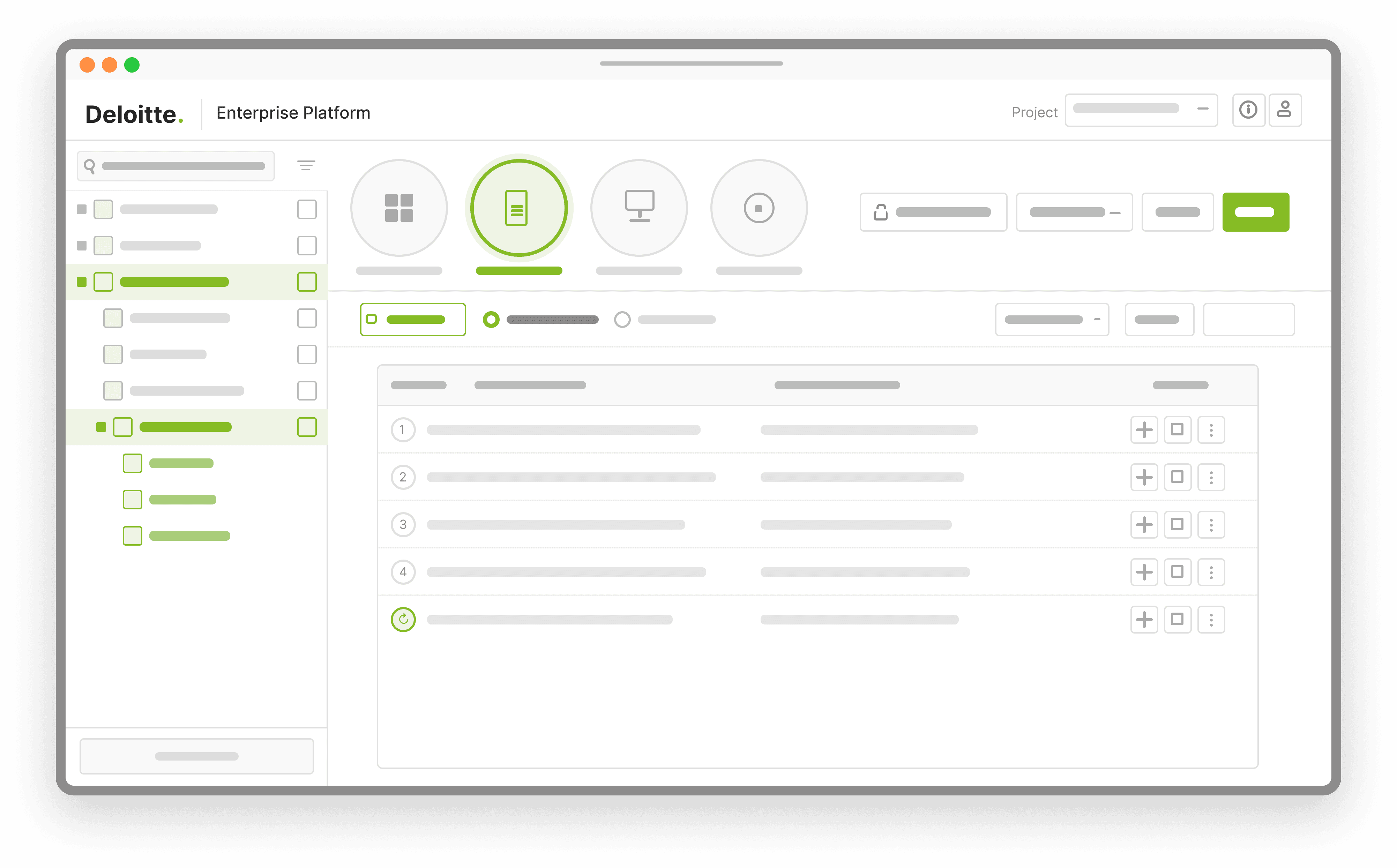
Enterprise UX is its own discipline, high-stakes, high-density, and unforgiving of friction. This is the work of bringing two third-party platforms in-house and rebuilding them around the habits their users had spent years perfecting, rather than overriding them.

Confidentiality Obligations

This article discusses the structural and foundational logic of the work done.

All proprietary content, research data files, process details, internal flow diagrams and interface details are withheld in accordance with confidentiality obligations.

Redacted versions available to verified employers upon request.

DELIVERY

Deloitte

Touche Tohmatsu

ROLE

UI & UX Designer

UX Researcher

SCOPE

Org Atlas

Total Testware

TEAM

Design & Content

Dev Team

//Scope

  1. Org Atlas

OrgAtlas is Deloitte's proprietary integrated analytics platform that helps organisations unlock value from their workforce data. The platform enables HR and talent leaders to ingest, analyse, and visualise data across talent dimensions , from culture and engagement to pay equity and unconscious bias , and surface actionable insights to drive workforce transformation.
  1. Total Testware

Total Testware is Deloitte's proprietary AI-based software testing platform, owned by Deloitte Shared Services. It serves as a comprehensive repository for managing test cases, test scripts, and test data, while enabling automated, AI-assisted test execution, reporting, and environment management. The platform targets QA engineers and testing professionals who require structured, auditable workflows at scale across enterprise projects spanning web, API, SAP, desktop, and database environments.

//The Problem

Two platforms users were quietly working against.

Both OrgAtlas and Total Testware were live by Phase 2. Both were being built to replace third-party tools that internal teams had operated daily, in some cases for the length of their careers at Deloitte. The brief wasn't to invent something better. It was to mirror what users already knew, then refine the friction out from underneath them , without breaking the familiarity they depended on.

That balance was failing. In trying to improve on the originals, the new tools had introduced friction the originals didn't have. Three breaks, none dramatic on its own. Together, they explained why expert users were slowing down, making errors, and resisting adoption.

Break 01

A

Monolithic load

Every profile loaded hundreds of unaligned data rows at once, none prioritised. No visual signal for where to look first. In compliance work, that ambiguity becomes error.

Break 02

B

Fragmented navigation

Audit trails, logs, and profile data siloed across 10+ nested tabs. A single review meant constant copy-pasting and tab-hopping to hold context the system should have held.

Break 03

C

Mismatched models

Fields grouped by backend storage category, not by the auditor's actual workflow sequence. Users translated between two logics on every task, a structural problem, not a usability one.

//The Research Framework

Arriving at what is "needed" & what is "wanted"

12 interviews with analytics leads, compliance auditors, QA engineers, and testing leads, wasn't built to validate assumptions. It was built to watch how people actually worked, and to map exactly where the new tools diverged from the habits users had carried over from the originals.
The finding that reframed everything: the friction wasn't only about layout or hierarchy. It was that the new interfaces had reorganised information in ways that broke the sequence experts already worked in — scan for outliers, validate context, trace logs. Improving the system had quietly overridden the muscle memory it needed to preserve.

The goal shifted from "make it better" to "make it better without making it feel different."

//Why Enterprise Differs

The rules consumer design plays by don't apply here.

Most design thinking is shaped by consumer products, and most of that thinking actively misleads when applied to enterprise. The difference isn't visual polish. It's the cost of friction and the fact that the user cannot walk away.

CONSUMER UX

If an app frustrates someone, they leave. Fast feedback loop, low stakes. The designer iterates toward clarity over time.

ENTERPRISE UX

Users can't leave. There's no alternative. The platform is the job, friction compounds across hundreds of people and thousands of hours, and in compliance contexts becomes real risk.

CONSUMER WORSHIPS WHITESPACE

If an app frustrates someone, they leave. Fast feedback loop, low stakes. The designer iterates toward clarity over time.

ENTERPRISE NEEDS DISCIPLINED DENSITY

Operators need situational awareness, that means data density. The job isn't to hide complexity to look clean. It's to discipline it so it reads at a glance, under pressure.

CONSUMER ONBOARDS NOVICES

If an app frustrates someone, they leave. Fast feedback loop, low stakes. The designer iterates toward clarity over time.

ENTERPRISE ASKS EXPERTS TO UNLEARN

Operators need situational awareness, that means data density. The job isn't to hide complexity to look clean. It's to discipline it so it reads at a glance, under pressure.

//The Hypothesis

What if improvement felt like continuity?

The instinct on a rebuild is to redesign, to fix everything visibly and show the improvement. The research pointed the opposite way. With expert users, familiarity isn't a constraint to design around. It's the feature that earns trust. The best version of this work would feel almost unchanged on the surface, while removing friction underneath.

The Bet

Preserve the sequence users already worked in, scan, validate, trace and refine within it, rather than imposing a new structure on top.

The Constraint

Every improvement had to feel like a natural extension of the familiar, not a replacement of it. A new tool that feels alien gets rejected, no matter how much better it actually is

//The Constraints

Designing inside real limits.

This was never a blank canvas. The work had to survive a rigid backend, an expert audience, and an organisation mid-migration.

Backend rigidity

STRUCTURAL


The data architecture was fixed. The design couldn't restructure how data was stored — only how it was surfaced. Every improvement had to work within the existing schema.


Expert muscle memory

HUMAN

Users had years of habit on the third-party originals. Any deviation from familiar patterns was friction. The design had to feel evolutionary, not revolutionary, even when the underlying change was significant.

Migration, not greenfield

ORGANISATIONAL

This was a replacement, not a new product. The tool had to match the capability of the vendor software people were leaving, while being owned, internal, and maintainable for the long term.

Near-zero error tolerance

CONTEXT

In compliance and QA environments, a misread or a missed signal carries real consequences. The interface had to reduce the conditions that produce errors, not just look cleaner.

//The Solution

A three-tiered canvas.

The core decision: stop treating the dashboard as a data container, start treating it as a workflow tool. The viewport was divided into three zones, each mapped to a stage in the auditor's cognitive sequence.

Backend rigidity

STRUCTURAL


The data architecture was fixed. The design couldn't restructure how data was stored — only how it was surfaced. Every improvement had to work within the existing schema.


Expert muscle memory

HUMAN

Users had years of habit on the third-party originals. Any deviation from familiar patterns was friction. The design had to feel evolutionary, not revolutionary, even when the underlying change was significant.

Migration, not greenfield

ORGANISATIONAL

This was a replacement, not a new product. The tool had to match the capability of the vendor software people were leaving, while being owned, internal, and maintainable for the long term.

Near-zero error tolerance

CONTEXT

In compliance and QA environments, a misread or a missed signal carries real consequences. The interface had to reduce the conditions that produce errors, not just look cleaner.

Powered by pixels and far too many dosas!

© Vibha Bharadwaj 2026 | All rights reserved

Powered by pixels and far too many dosas!

© Vibha Bharadwaj 2026 | All rights reserved

Powered by pixels and far too many dosas!

© Vibha Bharadwaj 2026 | All rights reserved