Enterprise Data Architecture: Scaling Density into Clarity
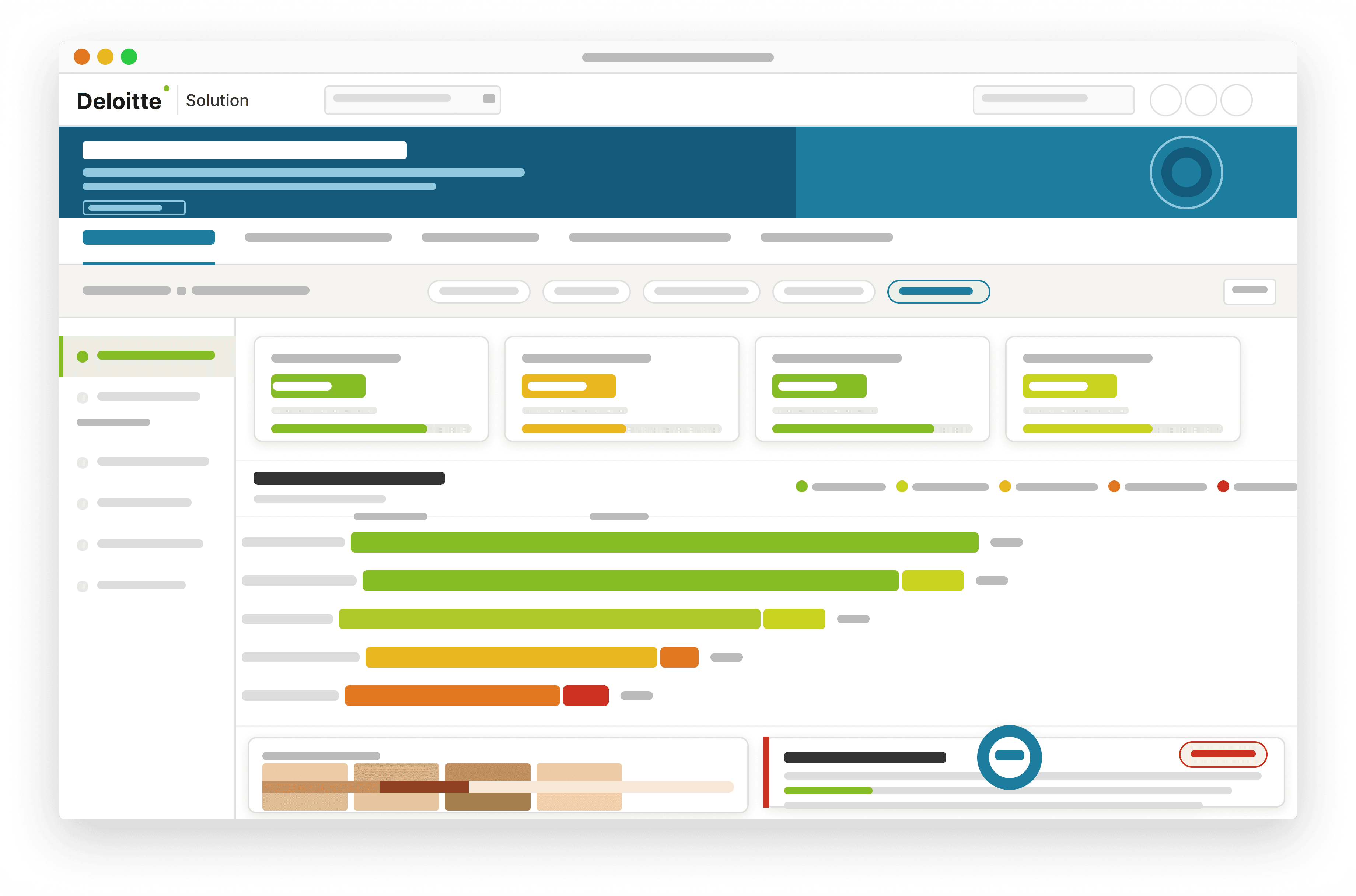
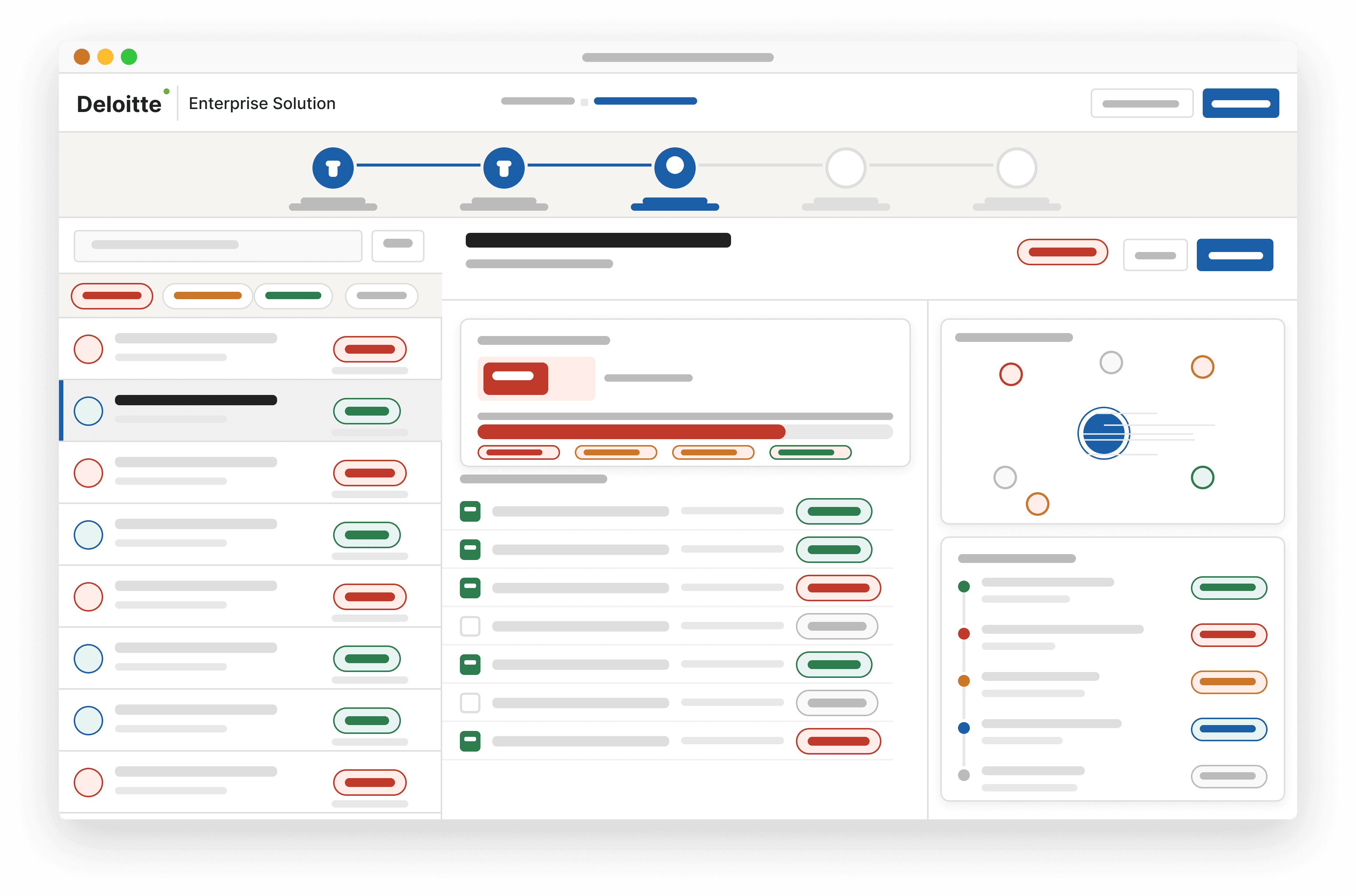
Designing the next generation of in-house enterprise tools for operational risk management. Across two major platform deployments, I championed end-to-end UX framework, mapping intricate relational databases to human logic to optimize internal auditing speeds, mitigate systemic friction, and establish rigorous corporate UX maturity.

The Objective
Re-engineering complex enterprise framework environments into modular, high-efficiency dashboard infrastructure. By aligning system behaviors with actual user mental models, this architecture cuts through legacy software constraints to streamline auditing cycles, preserve operator focus, and remove systemic friction.
Enterprise Suite
UX architecture for Deloitte’s proprietary internal platform ecosystems, transforming extreme data density into high-velocity workspaces.

Pedigree
Deloitte In-House Enterprise Infrastructure
The execution relied on rigorous relational data mapping, collapsing multi-page legacy pipelines into context-aware modules that keep system validation boundaries safe.
Core Logic

Confidentiality Protocol
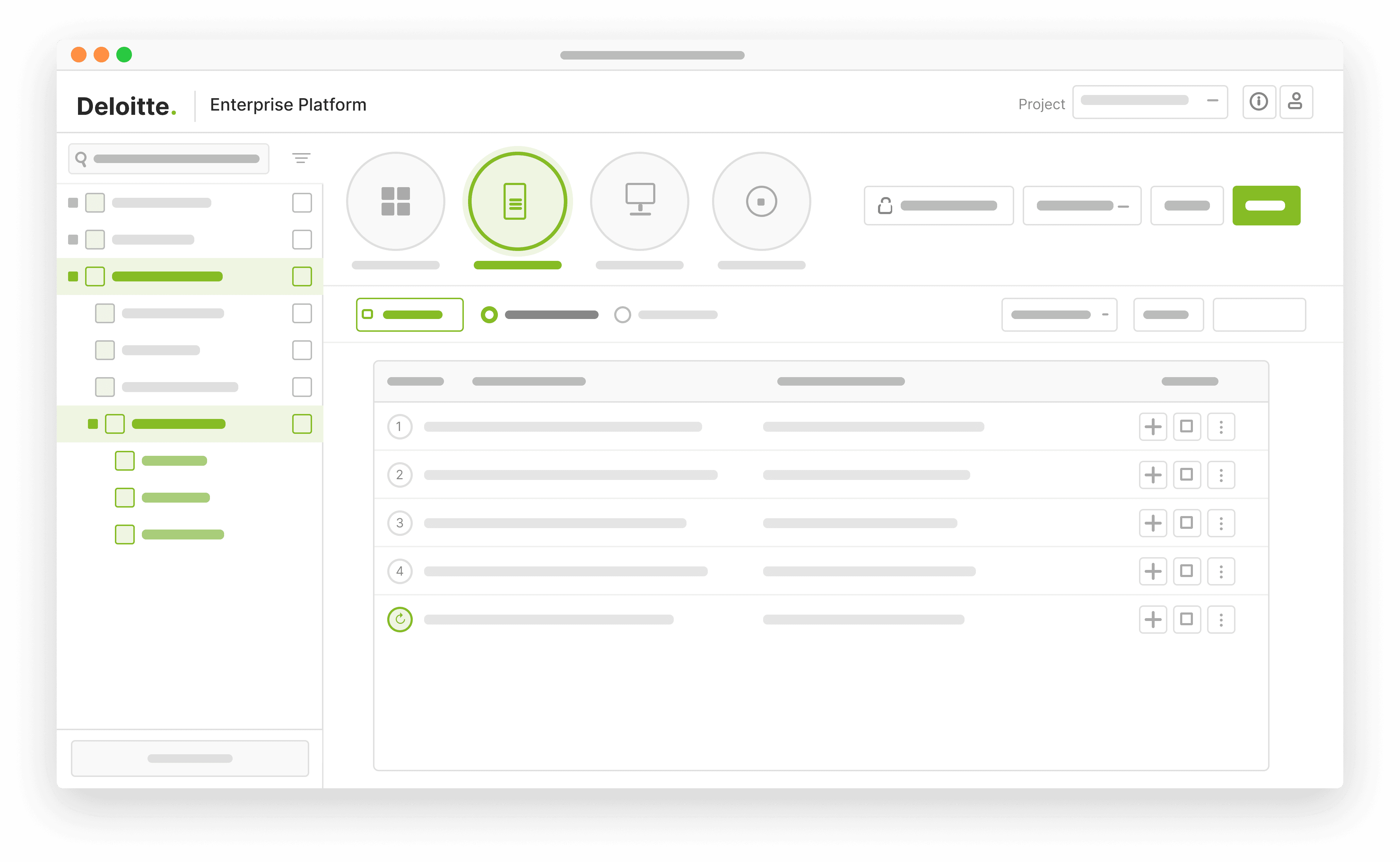
Covered under strict enterprise NDA. Proprietary interface layers have been stripped and reconstructed into functional wireframe schematics. This case study focuses exclusively on the underlying systemic strategy, data prioritization, and complex workflow architecture.
NDA


Senior UX Designer
Assistant Manager
The Architectural Deficit of Legacy Frameworks
The core challenge within complex validation software systems rarely stems from an absolute absence of data; rather, it is a critical deficit of structural and visual hierarchy.
Prior to this initiative, internal compliance, analytics, and due diligence teams were heavily reliant on brittle third-party legacy frameworks that exposed raw database schemas directly onto the user interface.
By forcing users to adapt to the machine's technical layout rather than structuring the interface around natural human workflows, the system introduced severe operational bottlenecks across three distinct failure modes:
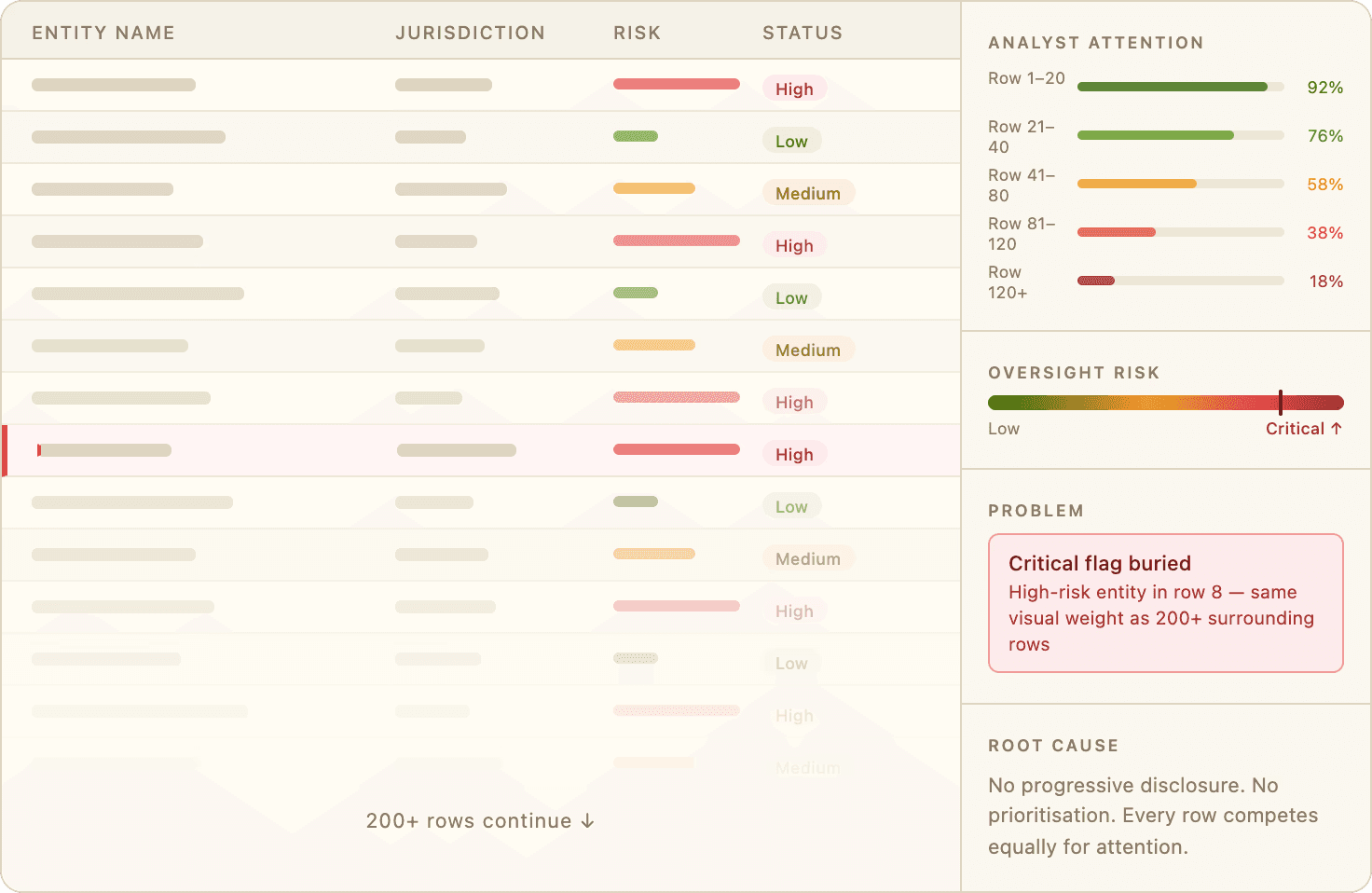
Monolithic Information Load:
Upon loading an enterprise profile, analysts were forced to scan hundreds of unaligned, non-prioritized data rows simultaneously. Without progressive disclosure parameters, intense visual fatigue accumulated rapidly, dramatically increasing the probability of data-entry oversight during high-stakes compliance checks.
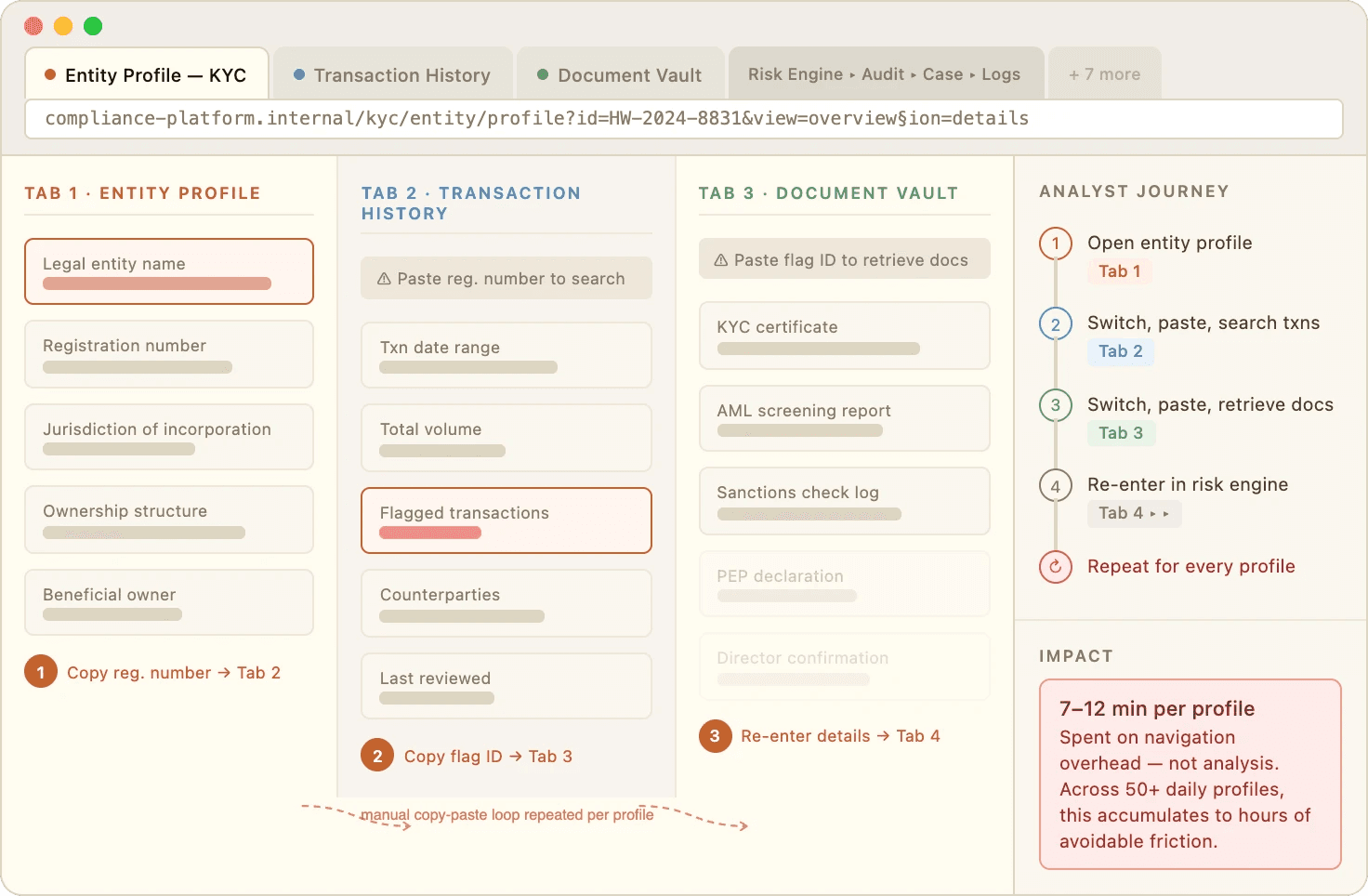
Fragmented Tool Navigation:
Essential auditing triggers, historic transaction trails, and documentation logs were entirely siloed across deep, nested browser tabs. A single standard profile review required exhaustive, repetitive cycles of copy-pasting, multi-tab hopping, and disjointed manual tracking.
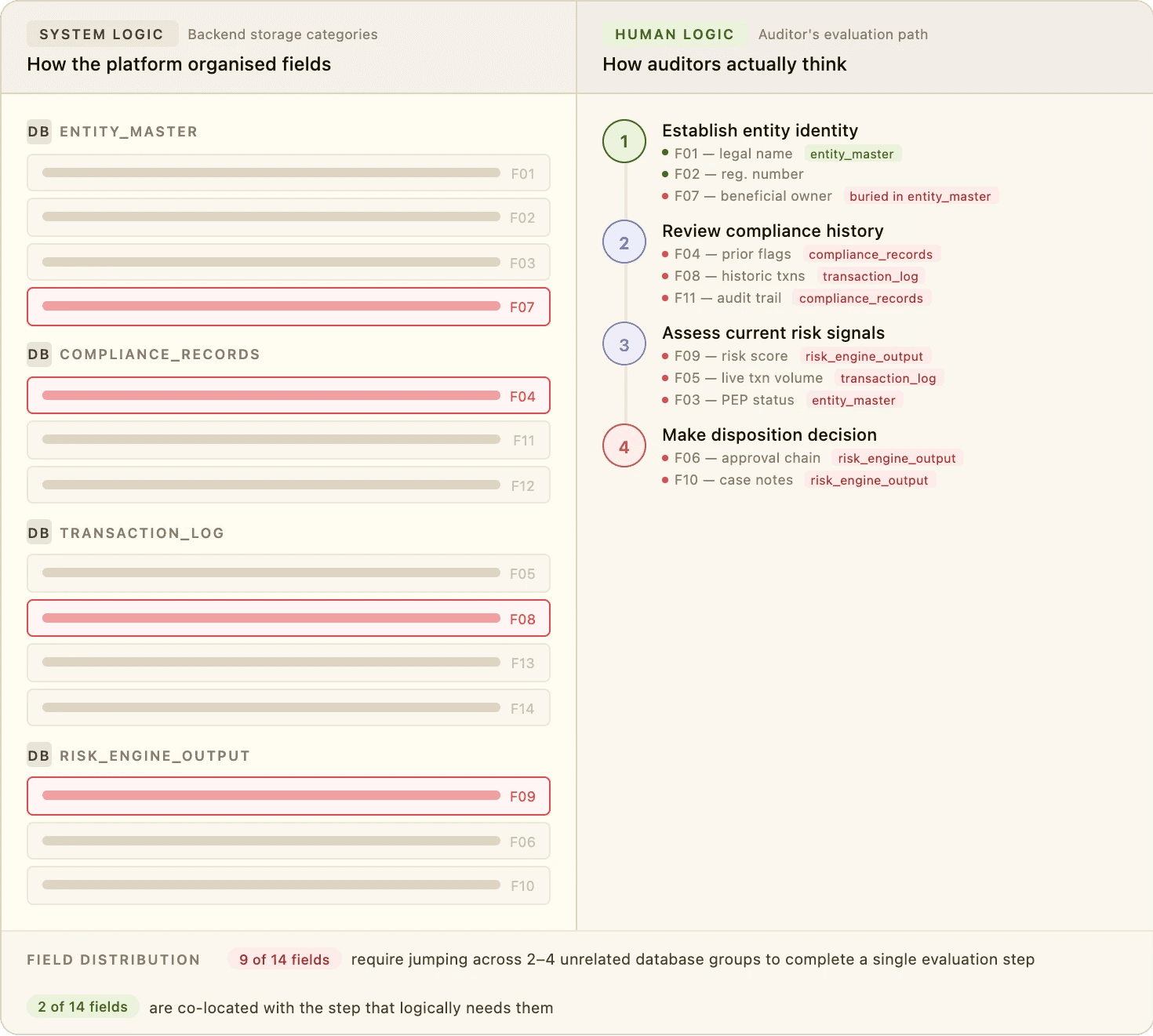
Mismatched Mental Models:
The platform layout grouped operational fields based strictly on backend storage categories rather than the natural chronological sequence of an auditor's evaluation path. This complete detachment from human logic actively worked against the user’s cognitive flow.
Deconstructing Complexity into Modular Workspaces
To scale down operational friction and eliminate the constant tab-hopping loop, the entire interface paradigm was re-engineered. Instead of treating the page as a passive data dump, the interface was broken down into clear, intent-driven zones designed to isolate cognitive focus and streamline real-time validation.
The layout framework was reorganized into a multi-tiered structural grid to ensure that data integrity remained perfectly secure while reducing the user's active processing strain:
The Persistent Core Anchor:
Critical high-level metadata—such as Entity Verification Status, Risk Tier, and Primary Identity Vectors—remains permanently locked at the top tier of the visual matrix, providing constant situational awareness.
The Active Operational Canvas:
A dynamic workspace module that automatically aggregates or collapses relevant input sub-tasks based exclusively on the current operational phase of the compliance review.
The Isolated Utility Core:
A responsive side drawer dedicated entirely to auditing histories, relational logs, and cross-reference records. This completely isolates deep contextual deep-dives from the primary workspace layout, eliminating layout drift.
Deep Architecture: From Ingestion Vectors to Diagnostic Logs
The primary validation of an intent-driven framework lies in its capability to handle fundamentally different data structures without fracturing the underlying design system.
When scaling this architecture across Deloitte’s internal platforms, the framework successfully reconciled two distinct operational paradigms:
Relational Network Mapping:
Managing high-density demographic data ingestion strings. The system architecture required a clean typographic hierarchy capable of scaling seamlessly from massive, multi-tiered enterprise overviews down to granular, individual profile data points—preserving context without causing layout breaking.
Real-Time Analytical Diagnostics
Structuring chaotic, fast-moving system logs and administrative test parameters. The interface model was optimized to surface real-time diagnostic indicators, allowing engineers and operations managers to pinpoint system anomalies, trace error origins, and execute deep administrative overrides cleanly on a single workspace canvas.
The Iterative Engineering Loop
Systemic clarity is not achieved through speculative design; it is proven through rigorous cross-functional validation. Over an intensive multi-week development cycle, the design framework was continuously stress-tested against real-world production environments to ensure complete technical stability.
Working in lockstep with internal engineering and backend infrastructure teams, we conducted deep logic reviews to ensure that our proposed user interaction mental models completely aligned with existing API capabilities and data-query constraints. By resolving complex backend limitations directly through intelligent layout optimization, we guaranteed that the platform maintained near-zero performance latency, even when handling immense enterprise data queries.
Establishing Enterprise UX Maturity
By treating complex dashboard layout design as an exercise in rigorous structural engineering rather than surface-level styling, the platform transformation successfully transitioned internal workflows from exhausting manual searches to an optimized, scanning-first verification pipeline.
The consolidation of OrgAtlas and Total Testware® into a unified, intent-driven architectural framework yielded immense dividends for the organization:
Systemic Optimization:
Completely eliminated the multi-tab navigation loop, dropping task-completion friction by containing all primary analytical actions within a single, context-aware screen environment.
Cognitive Load Mitigation:
Reduced visual fatigue and user oversight by hiding non-essential data parameters dynamically, scaling information display directly to active sub-task requirements.
Cross-Functional Velocity:
Created a highly reusable component specification language that bridges the gap between design requirements and front-end implementation, accelerating deployment speeds for subsequent enterprise tool updates.
