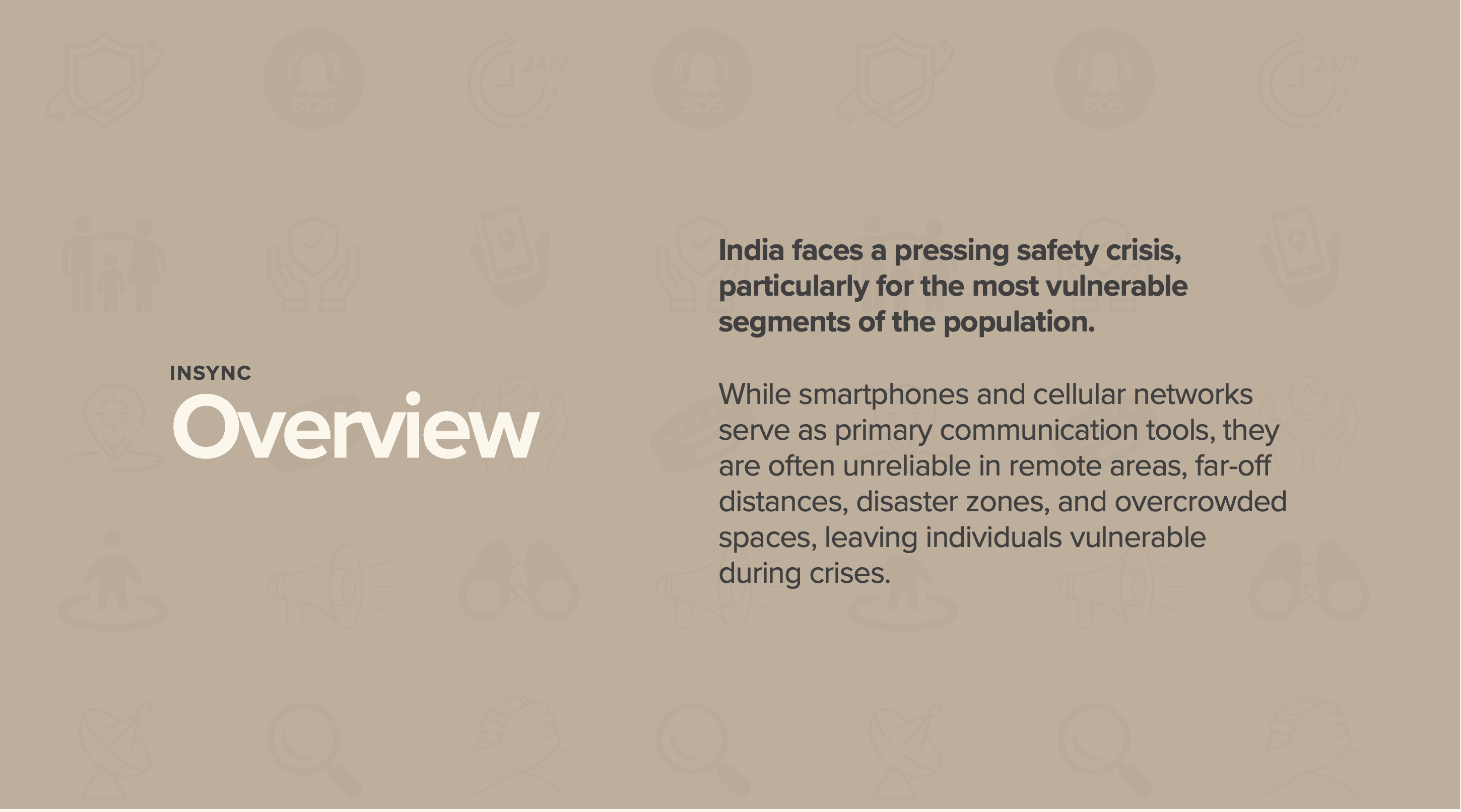
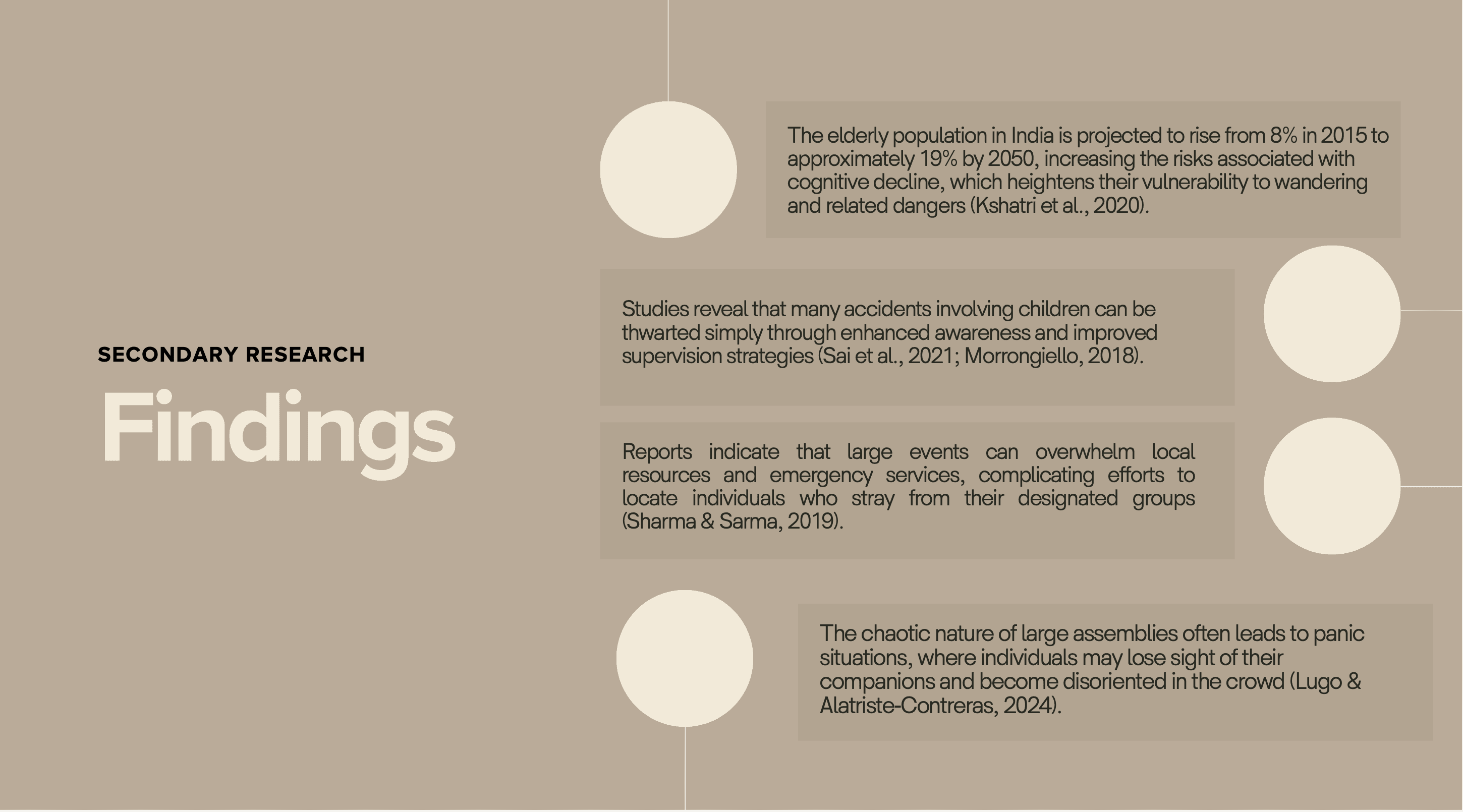
170,000+ children go missing annually in India. Elderly with dementia wander. Devotees get separated at mass gatherings like Kumbh Mela.
Existing wearables failed because they assumed stable cellular networks, individual device ownership, and high tech literacy, none of which exist for India's most vulnerable populations in crowded events, remote areas, or crisis moments.
Under panic conditions, these solutions increased cognitive load rather than enabling rapid location, especially in edge cases like ID mismatches, network congestion, or elderly users unfamiliar with smartphones.
The pattern was clear: Current safety tech optimizes for ideal conditions, not worst-case scenarios.
I led UX research and systems design for a dual-interface safety platform—defining the interaction model for both wearable and caregiver experiences. I translated complex technical constraints (satellite latency, battery life, offline operation) into clear, decision-ready interfaces.
Partnering with IoT engineers and NGO safety partners, I designed for the moment of panic—when every second matters and uncertainty is highest.
DESIGNING FOR WORST-CASE SCENARIOS
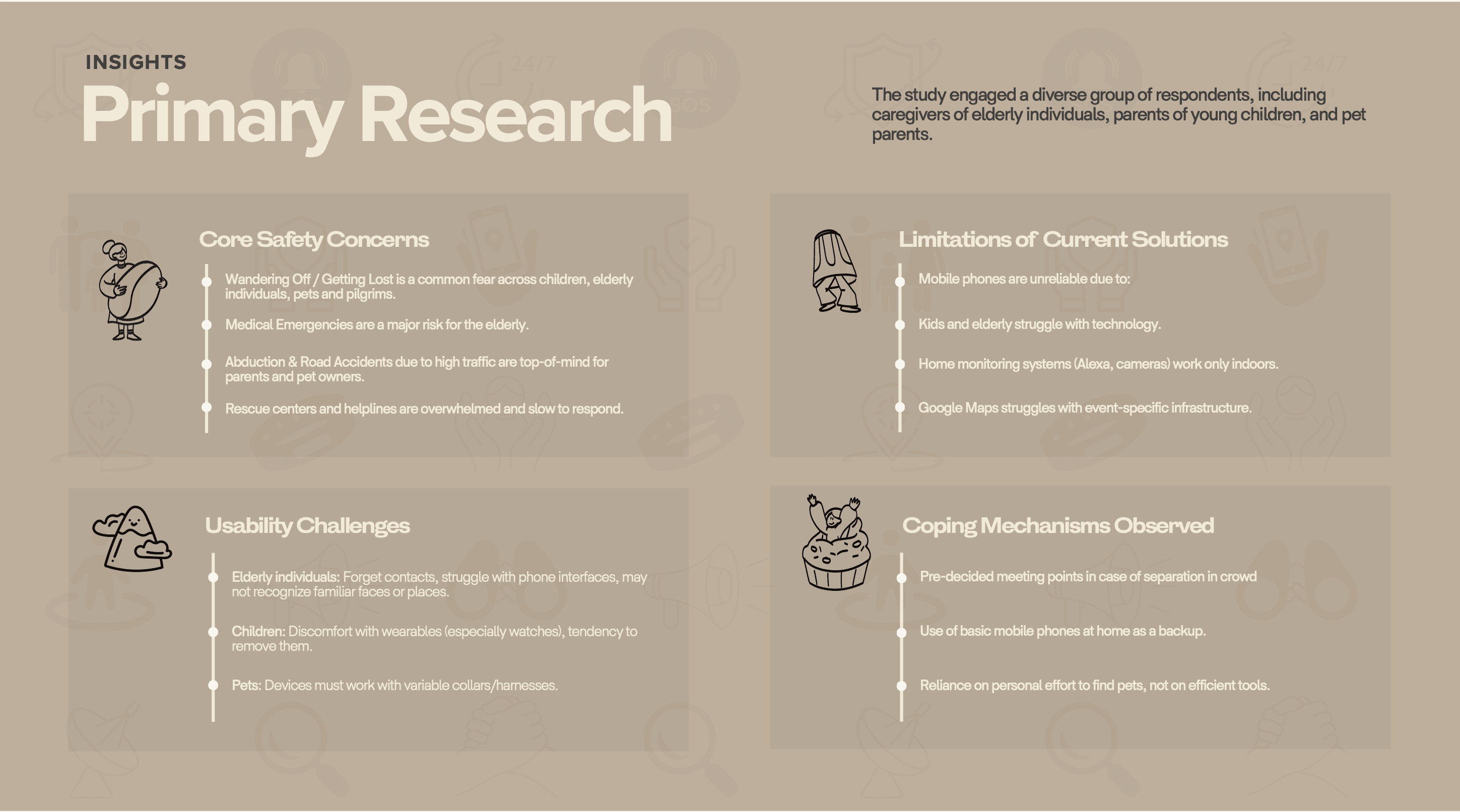
Through research with 4 NGO safety organizations, 7 caregiver interviews, and competitive analysis of 12 existing wearables, I uncovered recurring friction:
The critical insight: Wandering isn't the primary barrier—it's the inability to locate quickly during panic. Caregivers don't need features; they need certainty when networks fail.
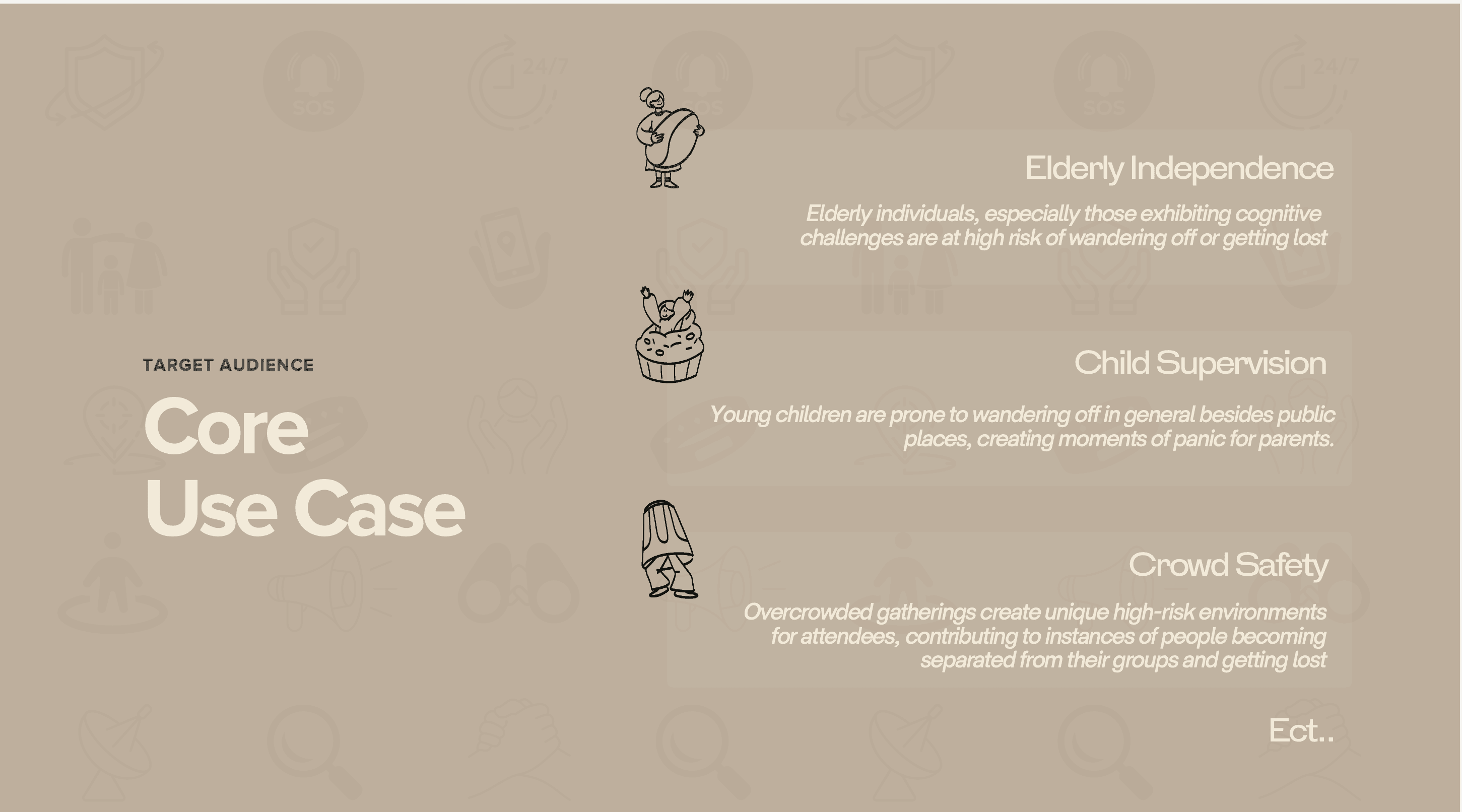
Research revealed 7 vulnerable user groups:
Children (under 12) in crowded public spaces
Elderly with Alzheimer's/dementia
Devotees at religious mass gatherings (Kumbh Mela: 100M+ attendees)
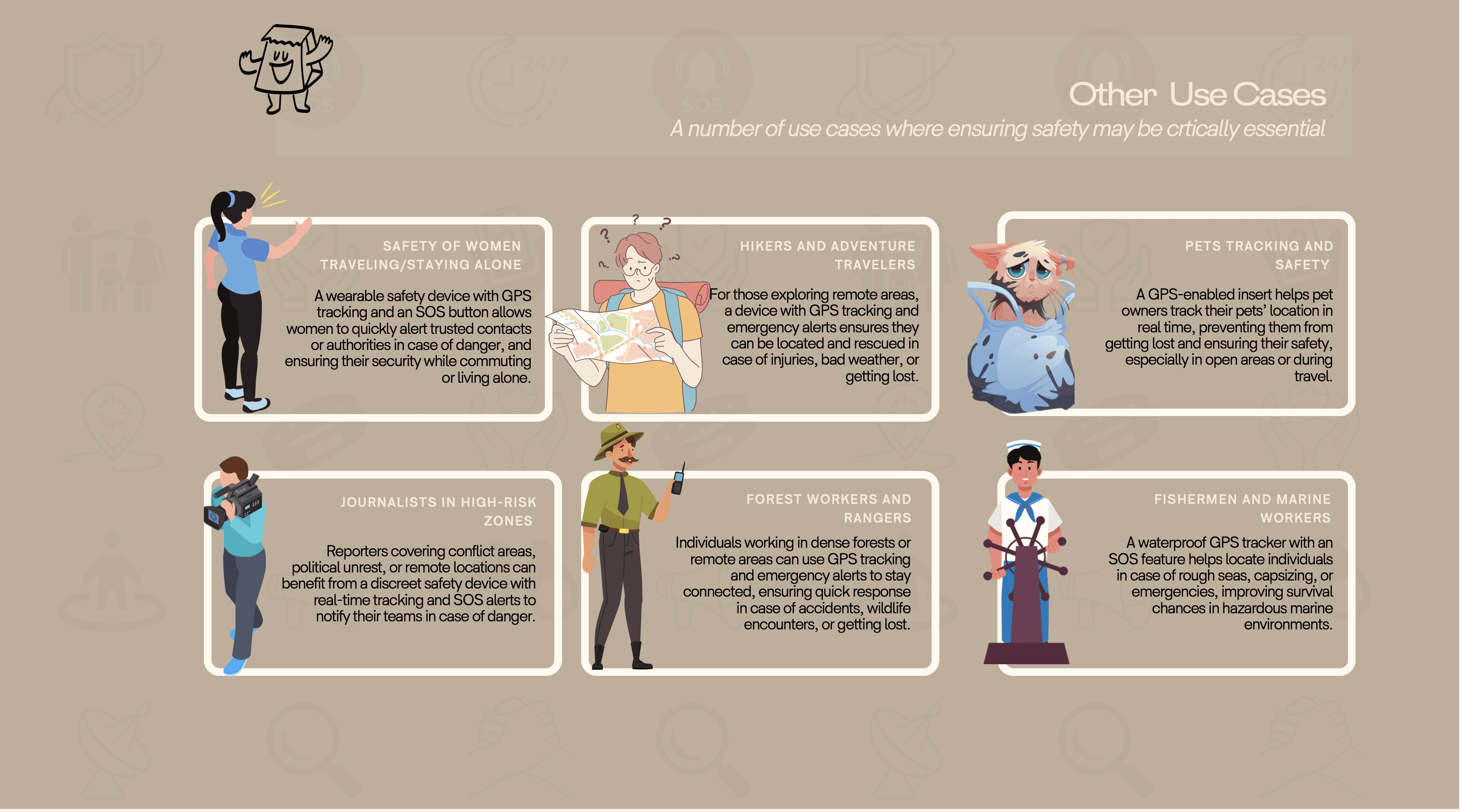
Women traveling alone in remote areas
Individuals with cognitive/developmental disabilities
Rural populations with limited cellular coverage
Emergency responders in disaster zones
Strategic decision: I prioritized satellite communication over cellular because reliability during network failure matters more than feature parity. This shaped every subsequent design choice.
Rajesh (68) – Alzheimer's Patient
Context: Lives with daughter in Bangalore; history of wandering
Needs: Lightweight, non-intrusive wearable; no complex interactions
"I don't want something that feels like a hospital bracelet."
Priya (34) – Caregiver (Rajesh's daughter)
Context: Working professional, high anxiety about father's safety
Needs: Real-time location, instant alerts, simple interface during panic
"When I can't find him, I can't think. Just tell me where he is."
Kumbh Mela Devotee (40s) – Mass Gathering Attendee
Context: Attending religious gathering with 100M+ people over 6 weeks
Needs: Family reunion capability when separated, works without cellular
"We got separated for 4 hours. The cell network was completely down."
The redesign sought to:
Enable real-time location when cellular networks fail
Reduce caregiver cognitive load during panic moments
Support offline operation and delayed sync
Create wearable design that users want to wear—jewelry-like, gender-neutral, culturally appropriate
Satellite IoT + Dual-Interface Design
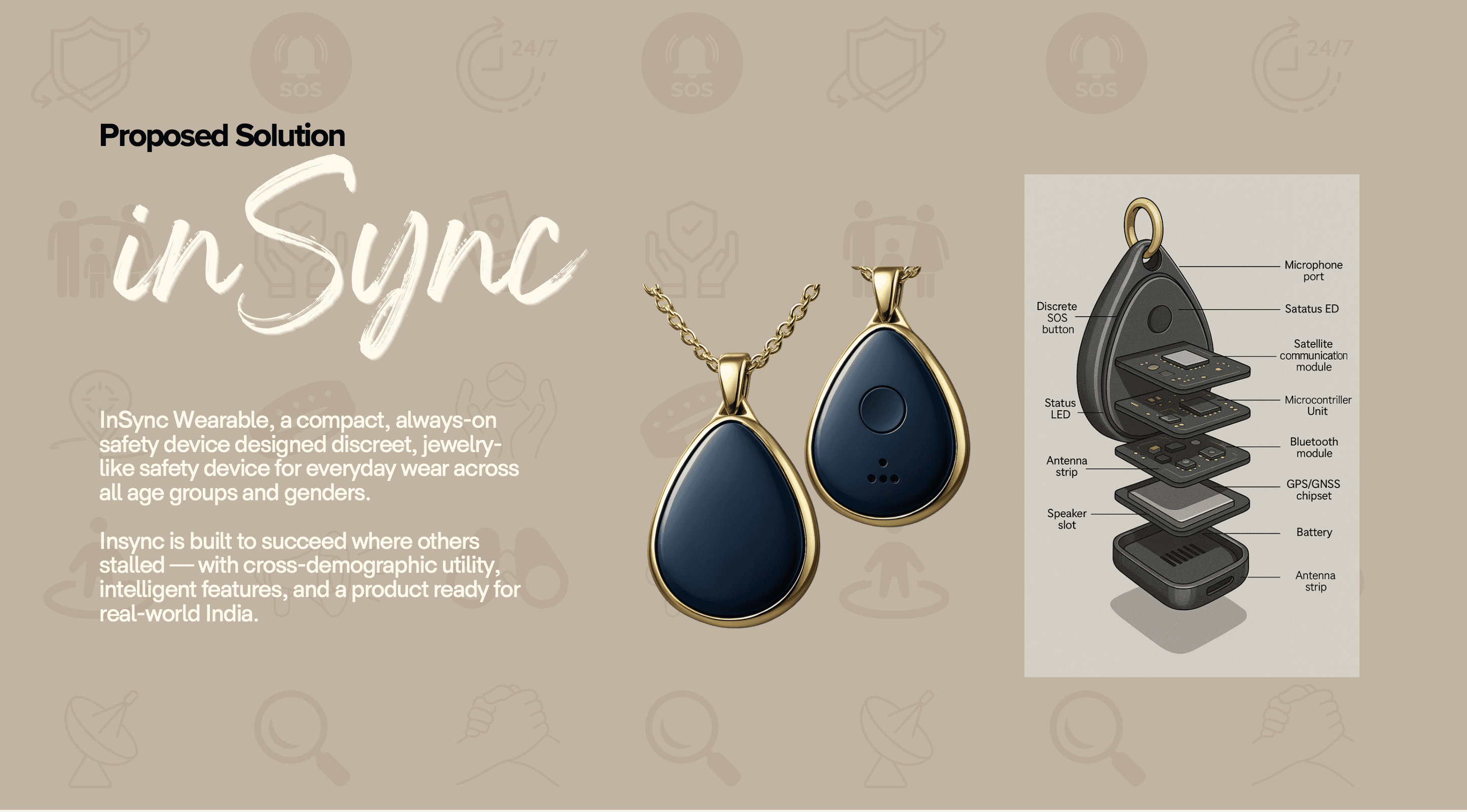
InSync is a Non-Terrestrial Network (NTN) wearable with real-time geo-fencing, AI movement detection, and two-way communication—designed to work when cellular networks fail.
Unlike consumer wearables (Fitbit, Apple Watch) that assume connectivity and feature richness, InSync prioritizes reliability over features—satellite tracking, offline operation, and panic-mode simplicity.
Three Strategic Pillars
1. Satellite-First Architecture
Designing for network failure, not ideal conditions:
Non-Terrestrial Network communication (satellite, not cellular)
Geo-fencing with customizable safe zones
AI movement pattern detection (wandering vs. intentional travel)
Offline operation with delayed sync
2. Panic-Optimized Interfaces
Reducing cognitive load when uncertainty is highest:
Wearable: One-button SOS, pre-recorded voice messages, no screens
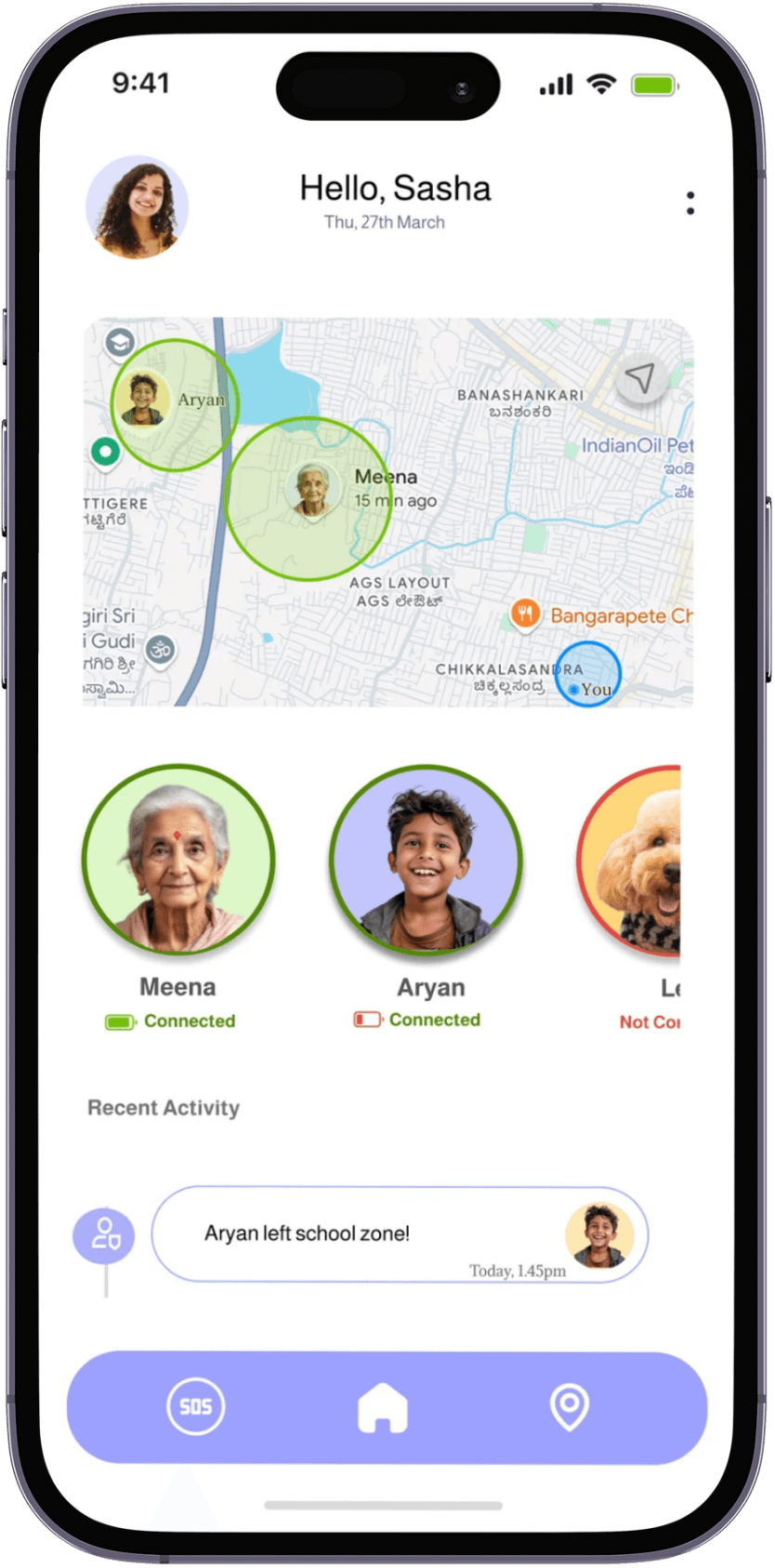
Caregiver app: Location-first design (map >> features), instant alerts
45-second average task completion (locate → act → confirm)
No multi-step flows during emergencies
3. Culturally Appropriate Design
Creating wearables people want to wear:
Gender-neutral, jewelry-like form factor
No hospital/institutional aesthetics
Lightweight (<50g), water-resistant
Battery: 7-day life (vs. smartwatch 1-2 days)
HOW THE SYSTEM WORKS
Wearable Device (Worn by Vulnerable Person)
Core Functions:
SOS Button: One-press emergency alert to caregivers
Voice Messages: Pre-recorded 2-way communication (no typing needed)
Movement Detection: AI detects wandering patterns vs. normal activity
Geo-Fencing: Automatic alerts when exiting safe zones
Design Constraints Solved:
No screen (reduces confusion for elderly/children)
No charging anxiety (7-day battery vs. daily charging)
No cellular dependency (satellite backup)
Caregiver App (Smartphone)
Core Functions:
Real-Time Location: Live map view with 10-second refresh
Alert Management: Instant push notifications with context (left safe zone, SOS pressed, battery low)
Historical Tracking: Movement patterns over time
Two-Way Communication: Send voice messages to wearable
Design Principles:
Location-first: Map occupies 70% of screen real estate
One-tap actions: Locate → Call → Navigate (no nested menus)
Panic mode: When SOS triggered, app locks to location screen
Decision 1: Satellite Over Cellular
Initial consideration: Hybrid cellular + satellite (cheaper, better battery)
Research revealed: Cellular fails precisely when safety matters most (crowded events, remote areas, disasters)
Final decision: Satellite-primary with cellular fallback
Trade-off: 3x cost, slightly higher latency (~5 seconds vs. instant)
Benefit: 100% reliability when cellular networks fail
Lesson learned: Design for worst-case scenarios, not average conditions.
Decision 2: No Screen on Wearable
Initial idea: Small e-ink display for messages/time
Caregiver feedback: Screen confuses elderly users, adds charging burden, increases cost
Final decision: Audio-only (voice messages via speaker, haptic feedback)
Trade-off: Less feature richness
Benefit: Simpler interaction, longer battery life, lower cognitive load
Lesson learned: Restraint is a design strength—especially for vulnerable users.
Decision 3: Pre-Recorded Voice Messages (Not Chatbot)
Initial idea: Open voice assistant for flexible communication
Testing revealed: Voice AI creates uncertainty ("Will it understand me?"), doesn't work offline
Final decision: Pre-set voice messages:
"I'm coming to get you"
"Stay where you are"
"Are you okay?"
"Call me when you can"
Result: Predictable, reliable communication without AI unpredictability
Measuring Impact Beyond the Interface
Prototype validation with 4 proxy caregivers showed rapid task completion and high confidence during simulated panic scenarios. More importantly, caregivers reported feeling "in control" during emergency simulations—a critical emotional outcome for safety products.
The system proved that reliability and simplicity are not opposing forces—when systems design prioritizes worst-case scenarios.
Usability Testing Results
Proxy Caregiver Testing (4 participants, 3 core tasks):
Task | Avg Time | Success Rate | Outcome |
|---|---|---|---|
Locate missing person on map | 12s | 100% | ✅ Success |
Send voice message to wearable | 8s | 100% | ✅ Success |
Navigate to last known location | 25s | 100% | ✅ Success |
Average Task Completion: 45 seconds (location to action)
Emotional Response (Post-Testing Interviews):
Aspect | Rating | Feedback |
|---|---|---|
Confidence | Very High | "I felt in control, not panicked" |
Clarity | High | "I knew exactly what to do" |
Speed | Very High | "Faster than calling everyone I know" |
Impact Summary
Technical Innovation:
✅ First satellite IoT wearable designed for India's vulnerable populations
✅ Offline-first architecture with delayed sync (works without connectivity)
✅ AI movement detection reduces false alerts
Real-World Alignment:
✅ Aligned with government safety initiatives (India's Missing Persons Framework)
✅ 7 vulnerable groups mapped (children, elderly, devotees, women, individuals with disabilities)
✅ Cost-effective at scale (target: ₹3,000-5,000 / $36-60 per device)
Design Innovation:
✅ Jewelry-like wearable design (not institutional)
✅ No-screen interaction (reduces cognitive load)
✅ Panic-mode simplicity (location-first UI)
1. Design for Worst-Case Scenarios
Early designs included step tracking, social sharing, and activity goals—competitive features from consumer wearables. Testing revealed these distracted from core safety needs. I learned to design for the moment when everything goes wrong, not when everything goes right.
2. Restraint Over Features
The best safety products do one thing perfectly. Removing non-essential features (screen, cellular-only, open AI) made the system more reliable, not less capable. Complexity is a liability when lives are at stake.
3. Emotional Outcomes Matter
"Feeling in control during panic" was the most important metric—more than task time or success rate. Safety products must address emotional needs (certainty, confidence, control) as much as functional needs.
"Safety tech must work when everything else fails. That's not a feature—it's the entire product."
— Product Vision Statement